Making Tax Digital for Income Tax (MTD IT) officially went live on 6 April 2026. The first two months have shown that implementation remains very much an active transition rather than a completed project.
Industry reporting suggested that many affected taxpayers had still not signed up shortly after launch, despite years of preparation and HMRC communications. At the same time, accountants and bookkeepers have now moved from planning for MTD IT to managing the operational reality of quarterly reporting in practice.
Whatever firms’ original views on MTD IT, the focus for most practices is now practical implementation and operational delivery.
For many firms, implementation work has continued well beyond the April launch date.
Many practices are still:
The first quarterly filing deadline on 7 August 2026 is rapidly becoming the next major operational focus.
Customers I have spoken with are seeing general business growth, although interestingly not linked directly to MTD IT at this stage. Of course, that may well change ahead of the first August filing deadline.
At the same time, firms are increasingly recognising that MTD IT is not simply a software or filing exercise. It requires ongoing operational processes capable of handling recurring obligations consistently across an entire client base.
For many firms, the core tax principles are familiar. The bigger change introduced by MTD IT is the frequency, overlap and continuity of reporting obligations.
Focusing on the busiest period, from August 2026 to May 2028, a single MTD IT client could generate 10 separate submission obligations spanning three tax years.

Multiply that across an entire client base and the resulting tracking and workflow challenge becomes immediately clear.
The challenge is no longer simply completing a single annual tax return. Firms must now manage overlapping recurring obligations, deadline visibility and work in progress across potentially hundreds or thousands of clients simultaneously.
In many cases, quarterly updates for a new tax year may already be underway while Final Declaration work for an earlier year is still being completed. This creates a much more continuous operational cycle than many firms have historically experienced for smaller sole trader clients.
The individual submissions themselves may not always be technically complex. The challenge comes from managing recurring obligations consistently across an entire client base on an ongoing basis.
The technical tax work itself may not change dramatically for many firms. The bigger challenge is often operational.
Quarterly reporting increases the importance of:
Many firms are also dealing with clients who still operate using spreadsheets, paper records or incomplete bookkeeping processes. In practice, the challenge is often not simply filing quarterly updates, but obtaining complete and timely information consistently throughout the year.
This means firms are often managing both compliance work and the operational challenge of client onboarding, education and ongoing information gathering.
Under MTD IT, firms increasingly need visibility not just of filing deadlines, but also:
As recurring obligations increase, relying on spreadsheets and manual reminders alone may become increasingly difficult to scale.
For many firms, the issue is no longer whether quarterly updates can technically be submitted. The bigger challenge is creating reliable operational processes capable of handling large volumes of recurring work consistently and efficiently.
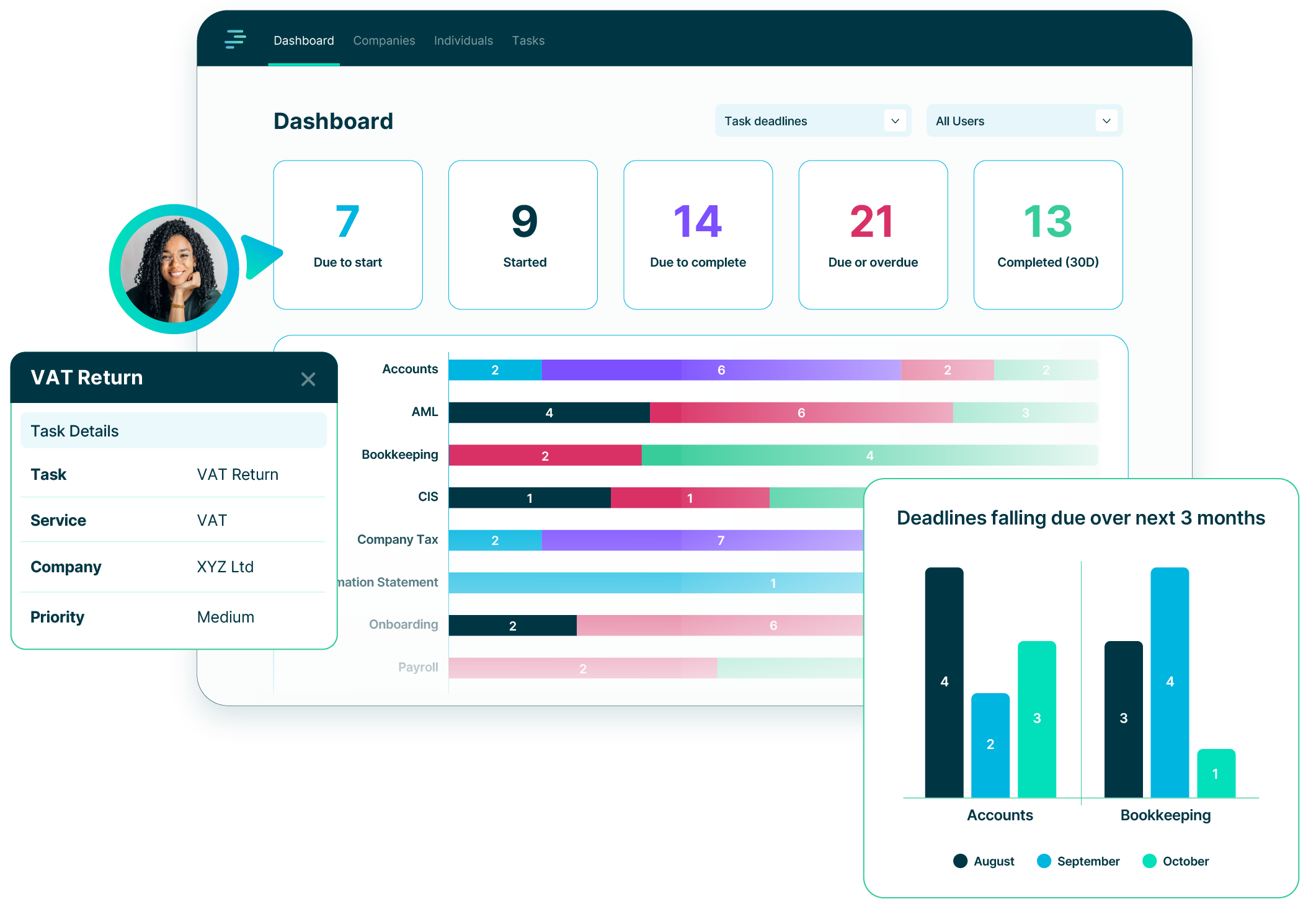
To support firms preparing for MTD IT workflows, we recently introduced enhanced functionality within PracticeFlow for:
We have also recently launched our new Client Portal functionality, helping firms manage recurring requests, document collection and client collaboration directly within workflow tasks.
As quarterly obligations increase, many firms are likely to place greater emphasis on reducing manual chasing and improving visibility over outstanding information requests and client responses.
The aim is not simply to record deadlines, but to help firms manage recurring operational processes more consistently as quarterly obligations increase.
At the same time, MTD IT may create opportunities for firms able to offer structured and well-managed processes to clients who previously handled compliance manually.
Although MTD IT is now officially live, the profession is still in the early stages of operational implementation.
The coming months, particularly ahead of the first quarterly filing deadline in August, are likely to provide a much clearer picture of:
The phased reduction in thresholds in 2027 and 2028 will also bring significantly larger numbers of sole traders and landlords into scope. For many firms, the current population may therefore represent only the beginning of a much broader operational transition.
Firms are also likely to continue reviewing:
As thresholds reduce further in 2027 and 2028, firms that establish strong operational processes early are likely to be far better placed than those still relying heavily on manual tracking and reactive deadline management.
If you would like to discuss MTD IT Smart Tasks or workflow setup within PracticeFlow, please contact support.
Join the growing number of UK accounting and bookkeeping practices using PracticeFlow to stay organised, meet deadlines, and focus on what matters most.