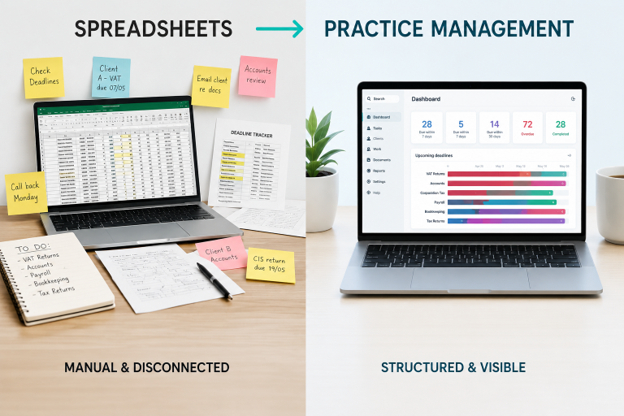
Many accounting and bookkeeping firms begin with spreadsheets.
They are familiar, flexible and already available within most businesses. For smaller firms managing a limited number of clients, spreadsheets often provide a practical way to track deadlines, organise work and maintain visibility over what needs to be done.
Many firms continue to use spreadsheets successfully for years.
Spreadsheets often work well for sole practitioners. As firms grow and additional team members become involved, maintaining visibility and coordination across the practice can become more difficult.
As client numbers increase, recurring obligations expand and more people become involved in delivering work, firms may begin to experience operational challenges that are harder to manage using manual systems alone.
As practices expand, the volume of work naturally increases.
More clients generate more deadlines. More services create more recurring obligations. Additional team members introduce a greater need for visibility and coordination across the practice.
It is not unusual to see one spreadsheet being used for deadlines, another for workload planning and another for tracking client information. While each may serve a useful purpose individually, maintaining consistency across multiple sources of information can become increasingly difficult. Different versions of information may emerge and important knowledge may become concentrated within individual team members rather than being visible across the firm.
Processes that once worked well for a small team may begin to require increasing amounts of manual oversight. As practices grow, keeping spreadsheets accurate and up to date can become a significant task in itself.
Although every firm is different, similar patterns often emerge as practices grow.
Firms may notice that multiple versions of spreadsheets exist across the team. Deadline tracking may rely heavily on individual knowledge or manual reminders. Recurring work may require significant manual updating.
Visibility over workload and work in progress can become more limited. Identifying who is responsible for a particular task may become increasingly difficult. Concerns may begin to arise about important deadlines being missed.
In some cases, firms begin creating additional spreadsheets to manage the limitations of existing spreadsheets. While this can solve an immediate problem, it can also increase the amount of manual maintenance required across the practice.
Many of these challenges arise when firms continue to rely on processes that were originally designed for a much smaller practice.
Many firms describe feeling that they are “just about keeping on top of things”, while simultaneously worrying about what might happen as the firm continues to grow.
Even when challenges emerge, many firms continue to rely on spreadsheets.
In many cases, this is entirely understandable. Spreadsheets are familiar. Existing processes may have evolved over many years and feel difficult to replace.
One of the most common things we hear from firms is a shortage of time. Many recognise the limitations of spreadsheets and manual processes, but they are already busy serving clients and meeting deadlines. Researching, selecting and implementing a new system can feel overwhelming when there is already too much to do.
As a result, improving internal systems often gets pushed down the priority list behind client work and deadlines.
We recently spoke to a customer who had already signed up for PracticeFlow but still hadn’t found the time to get started. When they finally set aside a day to focus on the setup, they were surprised to find they had reviewed everything they needed and configured the system for their practice in less than a day.
During conversations with firms reviewing practice management software, the requirements are often surprisingly similar.
Some firms place a greater emphasis on workflow, client communication and collaboration. Others are primarily concerned with managing tasks, deadlines and recurring compliance work.
However, regardless of how a firm chooses to operate, most still need confidence that nothing important is being missed, clear visibility over upcoming work and deadlines, better understanding of workload across the team and reliable management of recurring obligations.
Firms are also often looking to reduce reliance on manual processes and individual knowledge while maintaining systems that are intuitive and straightforward to use.
Practice management software is not necessarily the right solution for every firm at every stage.
For sole practitioners with relatively straightforward requirements, spreadsheets may continue to work effectively.
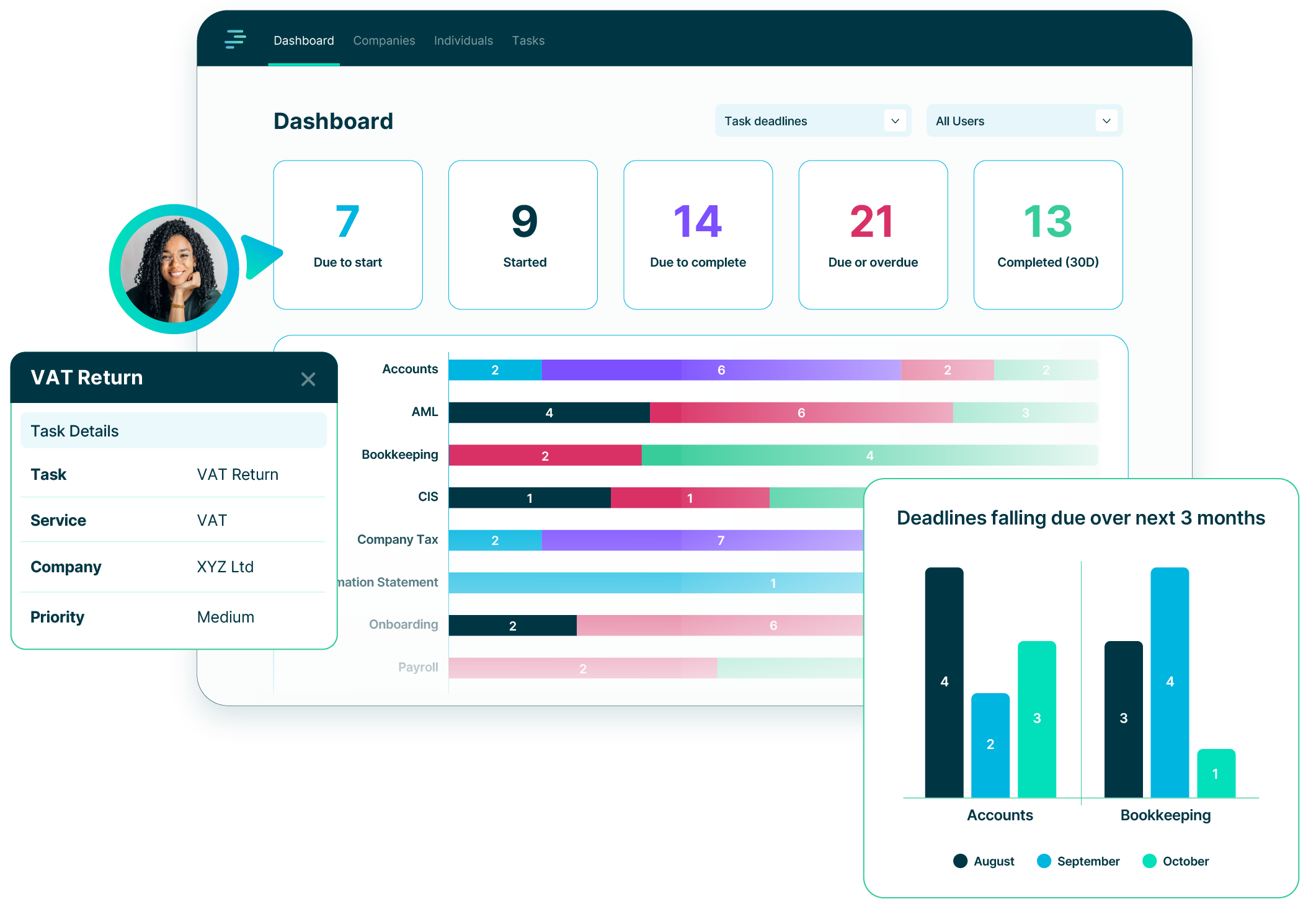
However, as firms grow, structured systems can help provide greater visibility over recurring work, improve ownership of tasks and reduce the manual effort involved in maintaining deadlines and workflows.
The transition does not need to happen all at once. Many firms continue to use spreadsheets for certain activities while introducing more structured systems for managing recurring work, deadlines and responsibilities.
Different practice management systems support different ways of working. The challenge is finding an approach that aligns with how a firm operates in practice, rather than introducing unnecessary complexity.
Spreadsheets have supported accounting firms for many years and continue to play an important role within many practices today.
For many firms, spreadsheets still serve a useful purpose and may remain part of the practice for years.
However, there often comes a point where manual tracking, duplicated information and limited visibility begin to place unnecessary pressure on both individuals and teams.
Recognising when that transition occurs may be one of the most important decisions firms make as they continue to grow.
Join the growing number of UK accounting and bookkeeping practices using PracticeFlow to stay organised, meet deadlines, and focus on what matters most.